How to Sharpen a Kitchen Knife on a Whetstone
How to sharpen a kitchen knife on a whetstone: soaking, the 15-20 degree angle, raising a burr and finishing — a calm ten-minute skill that changes cooking.
A dull knife is not a minor inconvenience; it is the most dangerous tool in the kitchen. Blunt blades skate off onion skins and tomato tops, demand force where they should need none, and turn a ten-minute prep into a wrestle. A whetstone fixes all of it in about ten minutes, and despite the mystique around sharpening, the skill itself is simple: one angle, repeated calmly.
Jump to section
This guide covers a standard double-sided water stone for an ordinary European or Japanese kitchen knife. It will not rescue a knife with chips or a broken tip — that is a job for a professional — but for the everyday dullness every knife drifts into, it is all you need.
What you need
A combination water stone — 1000 grit on one side for sharpening, 3000 or 6000 on the other for refining — covers most home knives. Very blunt knives may need a coarser 400-grit start. You also need a damp tea towel to stop the stone sliding, a bowl of water, and a steel or a leather strop for finishing if you have one. Keep the knife you use most for practice; your best knife can wait until the motion feels natural.
Step by step
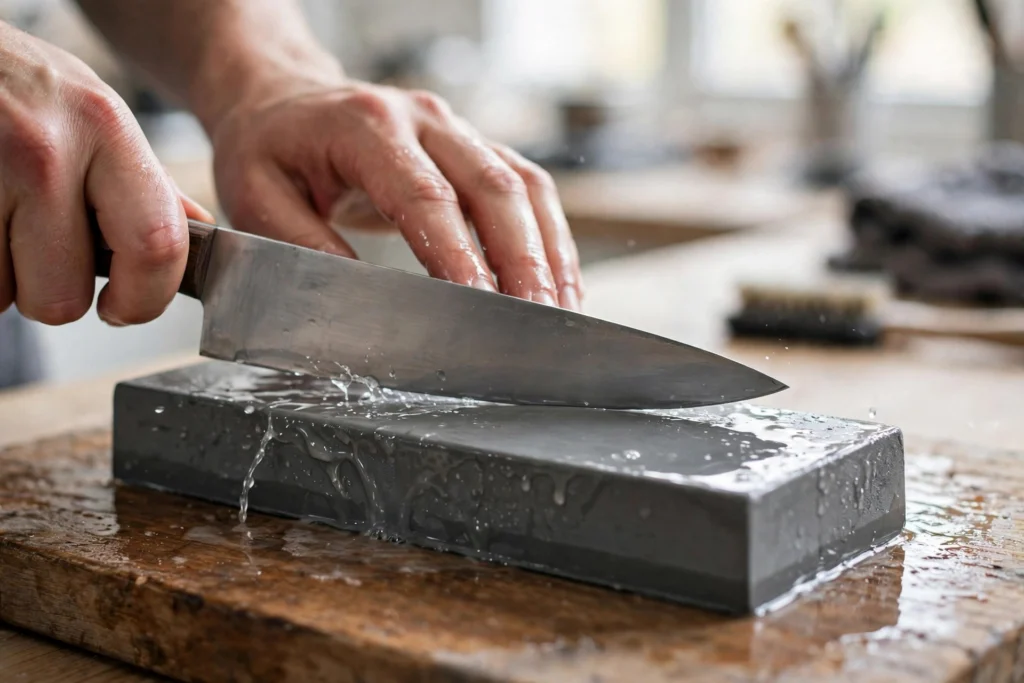
Soak the stone in water for five to ten minutes, until bubbles stop rising from it. Set it on the damp towel, coarse side up, on a surface at a comfortable height — you want your shoulders relaxed, not hunched. Hold the knife handle in your dominant hand and rest the fingertips of the other hand lightly on the blade’s flat, near the edge. The angle you are after is roughly 15 to 20 degrees for most kitchen knives: imagine the spine of the blade lifted about the height of two stacked coins off the stone.
Draw the blade across the stone in a smooth arc, from heel to tip, as if slicing a thin layer off the stone’s surface, using light, even pressure — let the stone do the work. Work in sections along the edge, keep the surface wet, and count your strokes: five to ten per section, then move along. You are raising a burr, a tiny curl of metal along the opposite side of the edge, and you should be able to feel it with a fingertip drawn carefully across (never along) the blade. When the burr runs the full length of the edge, turn the knife over and repeat on the second side. Then flip the stone to its fine side and repeat the whole process with lighter pressure to polish the edge, and finish with a few gentle strokes on a steel or strop, alternating sides.
The mistakes everyone makes
Pressing too hard is the first: it digs the edge in and rounds it rather than refining it. The second is letting the angle wander, which is why slow, counted strokes beat fast confident ones while you learn. The third is a dry stone — keep a small puddle on the surface at all times, topping up as you go. And test honestly: a sharp knife slices a sheet of paper cleanly and bites into a tomato skin under its own weight. If it tears the paper, the edge needs more time on the fine side.
Keeping the edge between sharpenings
A whetstone restores an edge; a steel maintains one. A few strokes on a honing steel before cooking realigns the edge and stretches the time between sharpenings to months. Store knives on a magnetic strip or in a block, never loose in a drawer where the edge knocks against other metal. Wash and dry by hand — dishwashers dull edges and ruin handles. And cut on wood or plastic boards; glass and stone boards will undo your ten minutes of work in a single dinner. A sharp knife makes recipes like our Classic Shepherd’s Pie with Cheesy Mash noticeably calmer to prepare.
Frequently asked questions
How often should I sharpen?
For a home cook using a knife daily, a proper whetstone session every two to four months, with regular honing in between, keeps most knives in good shape. Sharpen when the tomato test fails, not by the calendar.
Can I sharpen a serrated knife on a stone?
Not properly — serrated edges need a tapered rod worked into each gullet, or a professional service. The flat back of a serrated knife can be lightly polished on the fine side of the stone, nothing more.
What if I raise no burr?
Usually the angle is too shallow and only the shoulder of the edge is touching the stone, or the knife is blunter than a 1000-grit stone can handle quickly. Colour the edge with a marker pen, take two strokes, and look at where the ink is removed — it shows you exactly where you are grinding.
 Next up The Complete Guide to Cooking Rice Perfectly
The Recipe Nook is an independent recipe publication. Times and yields are stated plainly, as written — see our Editorial Policy.