How to Store Fresh Herbs So They Last Longer
How to store fresh herbs so they last up to two weeks: the bouquet jar for tender herbs, the damp wrap for woody ones, and the basil rule everyone breaks.
Fresh herbs have a reputation for dying fast, and it is mostly undeserved. A bunch of coriander that collapses in three days in a plastic bag will stay bright for a fortnight treated properly — the difference is knowing that herbs are not all the same, and that the fridge is a tool to use deliberately rather than a place to abandon them.
Jump to section
There are really only two methods worth knowing, plus one rule about basil. Learn which herbs belong to which method and the wilting-bunch problem largely disappears. The same thinking keeps garnishes ready for dishes like our Creamy Garlic Mushroom Pasta, where the parsley is not decoration but an ingredient.
Method one: the bouquet, for tender herbs
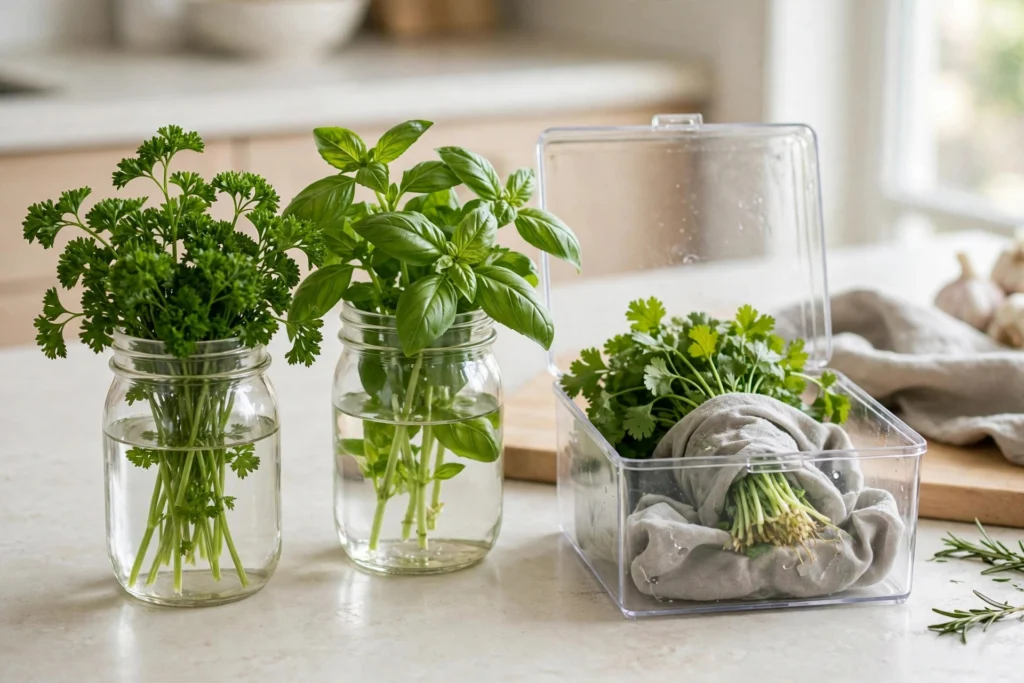
Parsley, coriander, mint and dill are essentially cut flowers. Trim the stem ends, stand the bunch in a jar with a few centimetres of water, and cover the leaves loosely with a plastic bag or a damp cloth. Keep the jar in the fridge — except for basil, which is covered below. Change the water every couple of days and snip off anything that yellows. Stored this way, parsley and coriander routinely last ten days to two weeks, and mint often roots itself and keeps growing.
Method two: the damp wrap, for hardy herbs
Rosemary, thyme, sage, oregano and chives prefer to be dry-ish and cold. Roll them loosely in a slightly damp sheet of kitchen paper, seal in a box or bag, and refrigerate. The paper holds a whisper of humidity around the leaves without wetting them, which is exactly the balance woody herbs want. Check weekly and replace the paper if it dries out. Bay leaves are hardier still and keep for weeks simply loose in the salad drawer.
The basil rule
Basil hates the fridge. Cold blackens its leaves and kills its perfume within days. Treat basil like a houseplant instead: stems in a jar of water on the counter, out of direct sun, and use it generously within the week. If a glut is coming — the plant is bolting, the bunch is huge — blend the leaves with olive oil and freeze the mixture in an ice-cube tray; the cubes drop straight into sauces all winter.
Rescuing herbs that have wilted
Before you bin a sad bunch, give it fifteen minutes standing in iced water. Tender herbs wilt mostly from water loss, and a surprising number come back crisp enough to use. Herbs too far gone for garnishing can still be chopped into soups, stews and herb butters, where looks do not matter. What you should not do is wash herbs before storing them: surface water speeds up rot. Wash them as you use them instead, and dry them well — a salad spinner earns its cupboard space on herbs alone.
Frequently asked questions
Should I keep the supermarket plastic packaging on?
No. The bags trap condensation against the leaves and accelerate sliminess. Transfer herbs to the jar or the damp wrap as soon as you unpack the shopping.
Can all herbs be frozen?
Soft herbs freeze well chopped into ice-cube trays with oil or water. Woody herbs freeze adequately whole in a bag. Delicate leaves meant for garnish never freeze well — the texture goes, even if the flavour survives.
How long do cut herbs last in the fridge drawer loose?
Two to four days for tender herbs, which is the baseline both methods above are beating. The drawer is not a method; it is where good intentions go to wilt.
 Next up How to Freeze Bread, Cake and Leftovers Properly
The Recipe Nook is an independent recipe publication. Times and yields are stated plainly, as written — see our Editorial Policy.